
TL;DR:
At the recent Power Platform keynote, Microsoft introduced the next chapter in low-code app development. One driven by intelligent agents, generative pages, and the full integration of Copilot Studio, Power Automate, and RPA.
The announcements signal a major milestone: the Power Platform is no longer just a development tool; it’s becoming an intelligent ecosystem where makers and AI agents co-create.
Reinventing App Development with AI
Microsoft’s latest updates mark a fundamental evolution in how business applications are built, scaled, and maintained.
The Power Platform is being reborn as an intelligent environment where AI agents, natural language prompts, and governed automation allow users to design end-to-end business solutions without writing code.
At the core of these updates are four key innovations:
- Generative Pages in Power Apps
- Users can now create model-driven applications by simply describing what they want in natural language.
- The system can connect to Dataverse tables, visualize data using Azure Maps, and even apply logic or formatting rules based on simple prompts.
- Example: Lumen Technologies used generative pages to build a full outage command center, reducing manual data entry through automation and intelligent form-filling.
- Data Entry and Data Exploration Agents
- Microsoft introduced new Data Entry Agents that can interpret information from unstructured sources, such as emails and automatically populate complex forms with dozens of fields.
- Data Exploration Agents let users perform data analysis conversationally, like asking, “Show me all critical outages in the Southeast grouped by incident status as a pie chart.”
- These capabilities significantly reduce manual work and improve accessibility for non-technical users.
- Collaborative App Development with AI Agents
- Microsoft unveiled a new model where specialized agents, including Requirements, Data, Solution, and Code Agents work together with the maker to build applications end-to-end.
- Each agent plays a defined role: structuring requirements, designing data models, and generating APIs, layouts, and multi-file code components.
- Example: State Farm’s operations team used these agents to create a training and onboarding app entirely from a single prompt, refining it further through simple chat commands and point-and-click controls.
- The Evolution of Copilot Studio
- Copilot Studio has now fully integrated with Power Automate and RPA, bringing agents, workflows, and automation into one platform.
- This allows makers to mix structured processes with open-ended AI interactions without needing separate tools.
- Over 200,000 organizations have already built agents through Copilot Studio.
Agents: The New Digital Workforce
Microsoft’s keynote clarified that agents are not just conversational bots.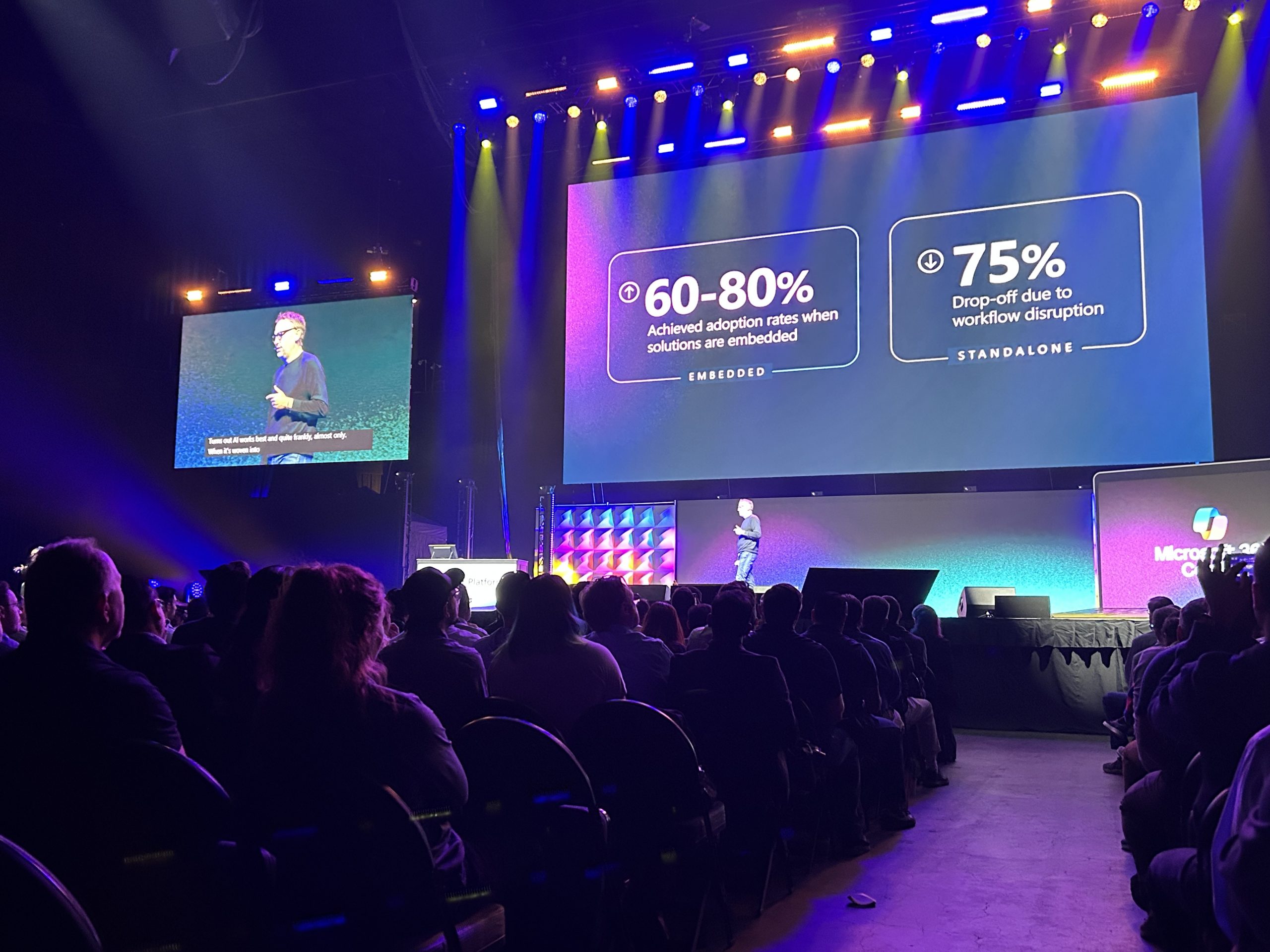
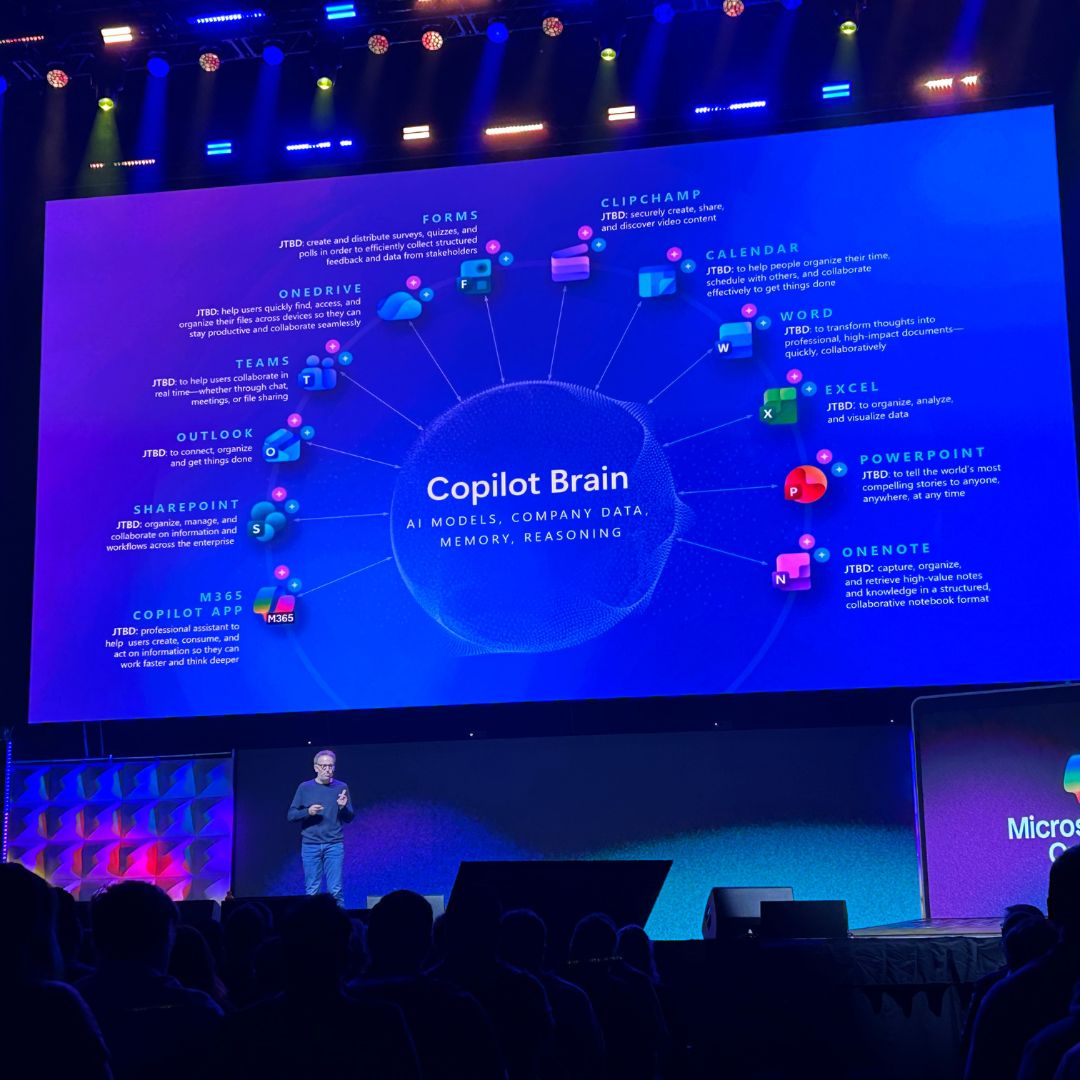
Each AI agent acts as a connected model, combining tools, APIs, data, and context to make decisions, take actions, and automate workflows in real time.
Examples shared on stage included:
- Agents that attend meetings, assist in decision-making, and execute tasks.
- Code Agents that autonomously build front-end and back-end logic.
- Data Agents that generate relational Dataverse models automatically.
This capability transforms agents into core digital participants within organizations, capable of reasoning, adapting, and acting at scale.
A Real-World Example: Nationwide’s AI-Powered Claims Flow
A standout demonstration featured Nationwide, which manages over 4.7 million insurance claims annually.
Using the new CopilotStudio.com, Microsoft showcased a claims workflow where AI handled multiple complex steps from data extraction to intelligent approvals:
- An AI prompt extracted details from claim documents and photos, then cross-referenced policy data in Dataverse to determine coverage.
- The prompt used reasoning, not just OCR, to correctly identify a pet’s breed, match it to policy records, and conclude whether the claim was valid, all from just three sentences of instruction.
- Intelligent approvals layered AI-based fraud detection and human oversight, routing claims dynamically between reviewers and departments.
- Workflows can now delegate specific steps to agents using an “execute agent action”, enabling seamless transitions from structured automation to adaptive intelligence.
The result: significant time savings, consistent accuracy, and a flexible governance model that blends automation with human decision-making.
What This Signals for the Microsoft Ecosystem
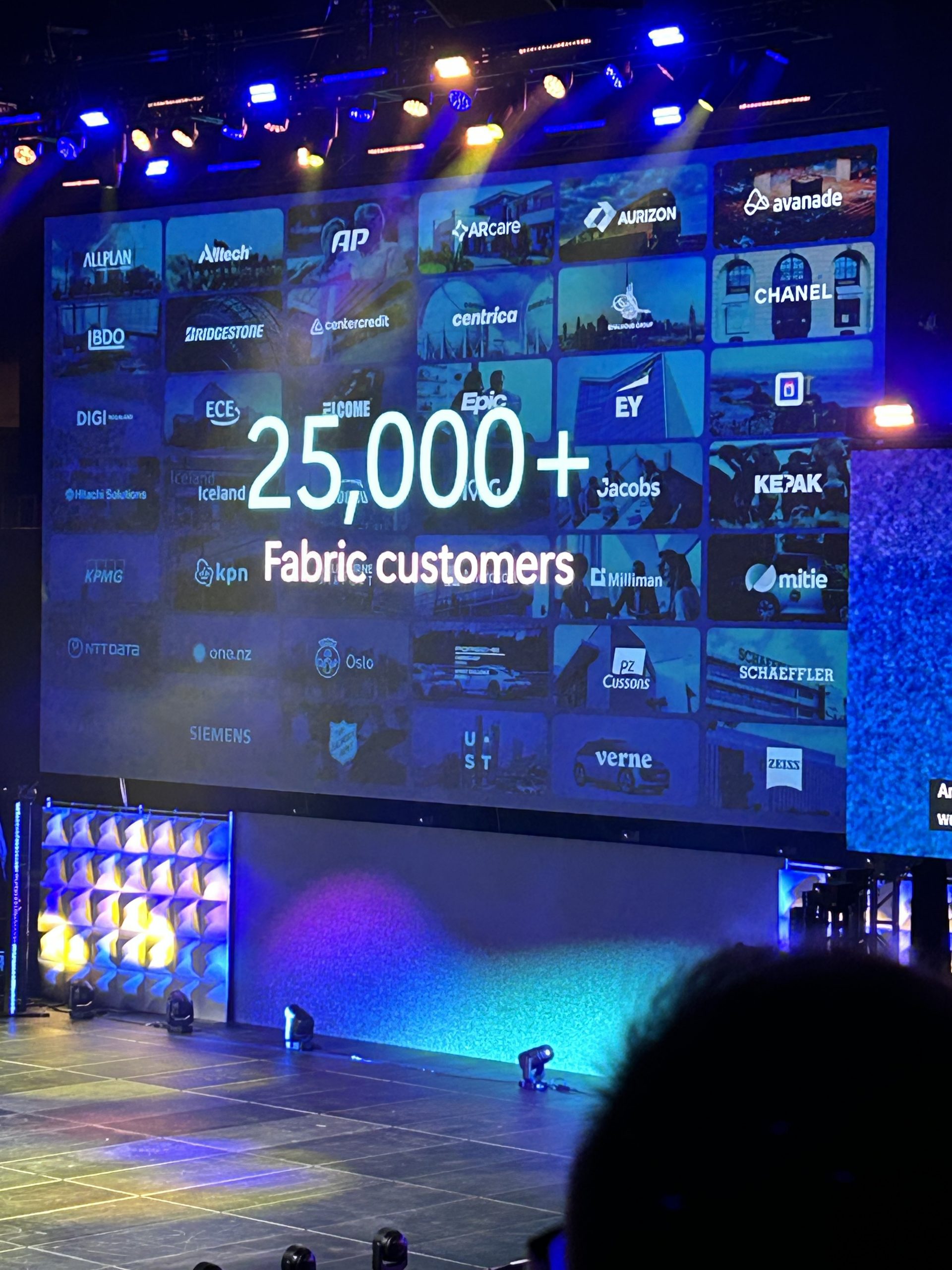 Every part of the keynote reinforced Microsoft’s direction: AI is becoming the fabric of application development.
The Power Platform is evolving from a low-code toolkit into a multi-agent development environment, where makers collaborate with intelligent systems to create governed, scalable, and adaptive applications.
This integration of Copilot Studio, Power Automate, and RPA into a unified experience underscores Microsoft’s long-term goal to democratize access to AI while maintaining enterprise-grade control and compliance.
Our Perspective: What This Could Mean for the Future of CRM
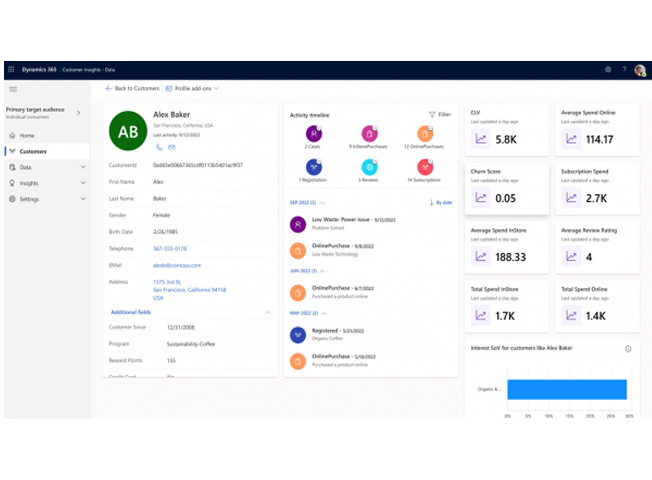
At TMC, Microsoft’s recent announcements mark a major turning point for CRM systems. The boundaries between CRM and the Power Platform are dissolving, with agent-driven automation, AI, and low-code tools now at the core of business application strategy. The focus is shifting away from legacy, monolithic CRM solutions toward interconnected, intelligent platforms that unify data and automate customer engagement at scale.
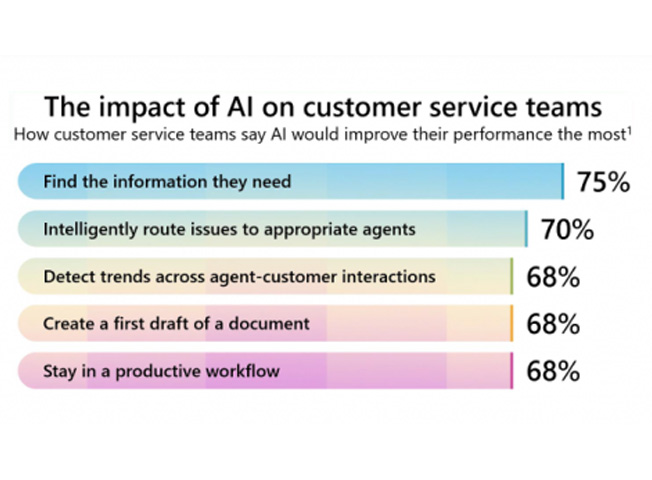
With Copilot and agent capabilities embedded in Dynamics 365 and the Power Platform, organizations can now automate tasks like data entry, case management, and customer communication—replacing manual processes with adaptive, predictive solutions that continuously improve through AI-driven insights.
Rather than CRM becoming obsolete, its traditional role as a static record-keeping system is ending. Instead, core CRM functionality is being reinvented through modular, agent-powered tools that optimize sales, customer service, and marketing interactions, as highlighted in Microsoft’s 2025 release wave plans. Businesses that modernize will operate customer engagement on intelligent platforms, delivering more responsive, connected, and automated outcomes.
Final Thoughts
The keynote reaffirmed what we’ve been seeing across Microsoft’s ecosystem: the rise of AI agents as co-creators, not just assistants.
As an AI-first Microsoft Partner, TMC is focused on helping businesses translate these advancements into practical solutions, preparing our clients for the next era of intelligent systems, where CRM, ERP, and automation all converge within a unified AI-powered platform.